Optimizing Hybrid Ultrasonic Testing Algorithms for District Heating Networks under Incomplete Spatial Metadata
Aleksandr Ivanaiskii, PhD
Industrial AI Founder & Systems Architect
Evgeny Ivanaiskii, PhD
Domain Expert
Sergei Shipilov
AI Architecture Lead, Rivixi LLC
Abstract
This paper addresses the problem of false positives generated by classical cross-correlation algorithms in acoustic leak detection systems when operating over long distances ( m) in municipal district heating networks. Under high attenuation and low signal-to-noise ratios, cross-correlation Z-score values saturate and generate spurious alarms driven by common-mode environmental noise — a failure mode that is fundamentally geometric in origin rather than spectral. We identify that the root cause of this pathology is not classifier capacity but metadata incompleteness: a systematic audit of a five-year operational database revealed that only 2.9% of historical diagnostic records contain verified distance labels, making full meta-classifier retraining intractable. To resolve this, we propose a physics-informed post-decision arbitration layer — a hybrid algorithm that integrates sensor separation distance as a physics-derived confidence constraint applied after the neural ensemble verdict, overriding the analog correlator's alarm when acoustic propagation physics predicts unreliable correlation at the observed span. This approach belongs to the Physics-Informed AI paradigm: physical domain knowledge compensates for the absence of labeled training data. The algorithm was experimentally verified on 110 real-world acoustic records from a district heating network. The proposed method reduced false positives by 20.9% (from 43 to 34) while fully preserving leak detection sensitivity (Recall: 63.3%), with overall accuracy improving from 50.9% to 59.1% (, McNemar's test).
1. Introduction and Relevance
Modern automated systems for acoustic leak detection in pipelines combine physical digital signal processing (DSP) methods and deep learning models. In the RIVIXI AI platform, decision-making is based on three independent modules:
- Cloud spectrogram classifier — analyzes 2D audio Mel-spectrograms to recognize the continuous hydrodynamic hiss characteristic of a leak.
- Edge AI classifier — analyzes the raw signal waveform in the time domain.
- Analog Defectoscope (Z-Score) — calculates the cross-correlation between two sensors to find the delay peak of the wave arrival.
However, wave propagation physics in steel pipes and liquid media imposes strict limits on the cross-correlation method. As the distance between acoustic sensors increases, the amplitude of the acoustic signal decays exponentially:
where is the attenuation coefficient, which depends on the pipe material, surrounding soil, and insulation. Over long distances ( m), the signal-to-noise ratio (SNR) approaches zero. Consequently, a classical correlator begins computing correlation peaks on ambient noise (groundwater boiling, traffic vibrations, pump stations), generating abnormally high, yet false, Z-Score values. This leads to an increase in false alarms and degrades the system's specificity.
To illustrate this physical phenomenon, the figures below display the spectral and correlation analysis of the same acoustic file, recorded on a real defect-free pipe section (with a nominal sensor distance of 50 m).
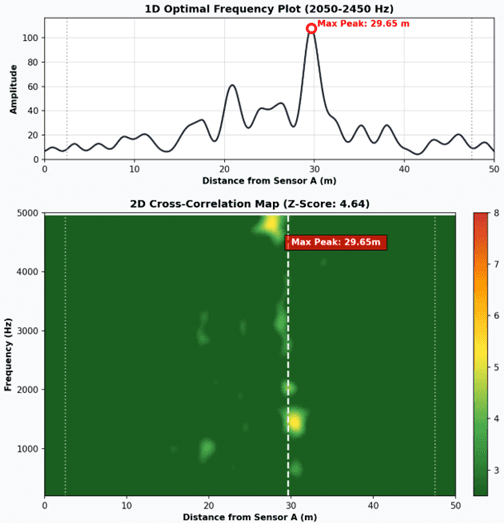
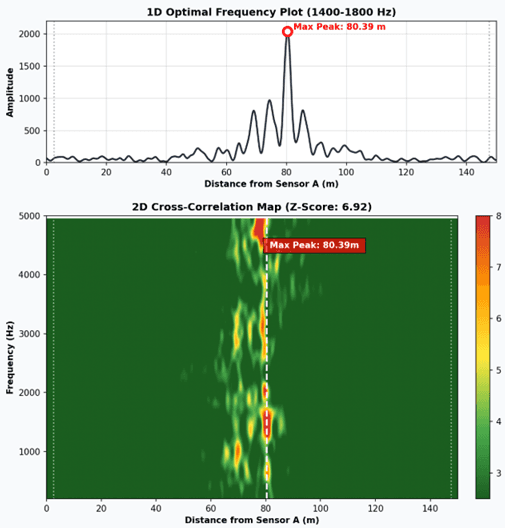
Physical analysis indicates that altering the geometric parameters in the device settings forces the classical correlator to rebuild its bandpass filters. Over longer distances, the high-frequency components of the useful signal are heavily attenuated, causing the filter to shift downward from the 2050–2450 Hz band to the 1400–1800 Hz band. Although this 600 Hz frequency shift is relatively small and leaves the visual spectral footprint virtually identical to a standalone AI model (such as a cloud spectrogram classifier analyzing Mel-spectrograms)—leading the pure AI model to incorrectly confirm a leak—it is physically critical for wave propagation in pipelines. Shifting the filter down to 1400–1800 Hz opens the system to low-frequency common-mode industrial hum (pump operations, 50 Hz power line harmonics) that reaches both sensors simultaneously, creating a false correlation peak at zero time delay (exactly at the center of the correlation card). In this scenario, the phase coherence spectrum acts as the sole reliable verification tool: despite the high Z-score and similar spectral pattern, it shows near-zero coherence across the 1400–1800 Hz band, exposing the peak as an isolated noise anomaly and preventing a useless excavation.
The integration of this control enables a multi-parameter arbitration process within the diagnostic ensemble. Because the RIVIXI AI platform utilizes heterogeneous models—an edge AI classifier analyzing the raw time-domain waveform, and a cloud spectrogram classifier recognizing spectrographic images—decisions cannot rely on Z-score alone. Each model exhibits distinct blind spots: the cloud spectrogram classifier is highly sensitive to steady-state frequency signatures but can be fooled by monotonic instrument noise, while the edge AI classifier evaluates temporal structures but is vulnerable to periodic pulsations. A top-level multi-parameter arbitration, triggered by spatial constraints, is required to verify the physical nature of the signal. If the ensemble neural network consensus (both edge AI classifier and cloud spectrogram classifier) fails to confirm a structural leak pattern within the 1400–1800 Hz band, the system vetoes the analog correlator's alert, suppressing the false alarm.
To improve the robustness of the model ensemble, spatial parameters of the pipeline segment must be taken into account. However, in real-world utility databases, these spatial metadata parameters are often missing or incomplete.
2. Related Work
The existing body of literature on acoustic pipeline leak detection can be organized into four categories, each of which partially addresses — but does not fully resolve — the problem motivating this paper: the degradation of algorithmic reliability under conditions of systematically incomplete spatial metadata. This taxonomy directly motivates the comparative analysis of solution strategies in Section 3.
2.1 Signal-Processing Improvements to Cross-Correlation
Classical cross-correlation between two acoustic sensors remains the standard method for leak localization. Foundational studies by Fuchs & Riehle [1] and Hunaidi & Chu [2] established the acoustic propagation characteristics of leak noise in buried pipes and identified sensor-distance limitations that are entirely consistent with the false-alarm regime described in this paper. The analytical model of Gao et al. [3] further showed that the correlation peak broadens and shifts unpredictably as propagation distance increases — a result that directly explains the Z-score saturation observed in our field data beyond 60 m.
More recent efforts focus on making the correlator itself more robust. PHAT-based cross-correlation [4] and Kolmogorov–Smirnov test-based time-delay estimation [5] suppress spurious correlation peaks from within the signal-processing layer. However, these methods still treat the correlation output as the definitive decision variable and do not question its validity when spatial configuration parameters are unknown. Our approach departs from this paradigm: rather than refining the correlator, we introduce an external veto layer that explicitly invalidates the correlator's verdict when the geometric context makes it physically unreliable.
2.2 Deep-Learning Classifiers for Acoustic Leak Recognition
Neural architectures operating on Mel-spectrogram and MFCC representations have demonstrated strong classification accuracy in controlled experimental settings [6], [7], [8]. Hybrid 1D+2D-CNN architectures [9], [10] and pseudo-siamese MFCC feature fusion [11] further reduce dependence on any single feature type, improving generalization across pipe materials and operating conditions. However, all of these studies assume access to clean, fully annotated datasets collected in controlled or single-site conditions. None of them address the scenario where a key geometric feature — sensor separation distance — is present in fewer than 3% of available training records. This is precisely the scenario that characterizes operational databases of municipal diagnostic platforms, and the one this paper addresses.
2.3 Multi-Algorithm Fusion and False-Alarm Suppression
Several recent works demonstrate that combining heterogeneous detection signals can significantly reduce false alarms compared to single-modality systems [12], [13]. Proposed frameworks range from Dempster–Shafer belief fusion [14] to acoustic–hydraulic data-level integration [15] and ensemble gradient-boosted classifiers [16]. These end-to-end fusion strategies, however, require sufficient labeled training data for all input features to learn reliable fusion weights. When spatial metadata is nearly absent from the training corpus — as is the case in our study — any learned fusion is likely to degenerate due to extreme feature sparsity. This motivated our decision to adopt a deterministic, physically grounded override rule rather than a trainable fusion layer.
2.4 Leak Detection in District Heating Networks
District heating (DH) infrastructure introduces specific challenges not present in water or gas transmission pipelines: higher temperatures, complex insulation layers, denser urban interference, and stricter regulatory audit trails. Early field studies [17] established the feasible detection range for pre-insulated DH pipes under real urban noise conditions. A comprehensive 2025 review [18] explicitly identifies elevated false-positive rates as an open problem for acoustic DH monitoring, noting that no satisfactory noise-rejection layer exists at the system level. Our work directly targets this gap for the specific case where false alarms are geometrically conditioned by sensor span. Recent DH-specific ML approaches [19] further confirm the trend toward ensemble decision-making, though they do not address the metadata scarcity problem.
2.5 Wave Physics Underlying the Distance Threshold
The physical justification for the distance-dependent degradation of correlator reliability rests on classical pipe acoustics: the Moens–Korteweg wave speed formula [20], later extended by Joukowsky for transient hydraulic analysis, shows that elastic pipe deformation reduces apparent wave celerity in a length-dependent manner. Contemporary transient-analysis standards [21] confirm that this correction is non-negligible for spans exceeding several tens of meters. Critically, the specific distance at which correlation reliability degrades is not a universal constant but depends on pipe diameter, wall material, insulation type, and operating frequency range. In the investigated district heating network configuration, this transition was empirically observed to begin around 60 m, and all claims in this paper are scoped to this specific system context.
2.6 Gap Addressed by This Work
Synthesizing the above, the existing literature offers four broad classes of solution for improving acoustic leak detection reliability: (1) improving signal-processing within the correlator, (2) improving neural-network feature extraction, (3) training a fused meta-classifier on combined features, and (4) introducing external decision logic. Categories 1–3 all presuppose data conditions that do not hold in our operational setting. This paper therefore focuses on Category 4 — a hybrid, metadata-conditioned veto filter — and provides the first systematic comparative analysis of these four solution archetypes under the constraint of severe spatial metadata incompleteness.
3. Analysis of 4 Spatial Metadata Integration Strategies
The four solution categories identified in Section 2 translate directly into four concrete engineering options for modifying the existing diagnostic pipeline. Each option was evaluated against the same criterion: correctness of algorithmic decision-making under the constraint that sensor distance is available for only 2.9% of historical records.
Before examining these options, it is essential to clarify the physical basis for the approximately 60-meter distance that serves as a key transition point in our algorithmic flowcharts and tables. This value was empirically observed in our specific district heating network configuration and is conditioned by three interconnected factors. It should not be interpreted as a universal constant: the exact threshold depends on pipe diameter, wall material, insulation type, and the frequency response of the installed sensors. For the investigated network, the transition region was consistently observed to begin near 60 m, and all claims in this paper are scoped accordingly.
- Exponential Attenuation (consistent with Stokes-Kirchhoff absorption models): High-frequency components of acoustic emissions (above 1.5–2 kHz), which carry the most distinct signature of a point-source leak, are rapidly absorbed by the surrounding soil and pipe insulation. Over distances exceeding 60 meters, the useful leak signal in this band is completely damped out, reducing the signal-to-noise ratio (SNR) to near-zero levels.
- Parasitic Filtering Shift: To compensate for high-frequency attenuation on spans longer than 60 m, correlators are forced to rebuild their bandpass filters to target lower frequency bands (1400–1800 Hz and below). This lower frequency window captures common-mode industrial and environmental noise (50 Hz electrical grid harmonics, pump vibrations, traffic), which reaches both sensors simultaneously and generates a false correlation peak exactly at the center of the correlation card ().
- Accumulated Wave Speed Discrepancy (Korteweg's wave speed equation for elastic pipes): The speed of sound in water-filled steel pipes is reduced by the elastic deformation of the pipe walls. If the algorithm uses standard sound speed constants (uncorrected), the localization error is negligible on short spans but accumulates on distances longer than 60 meters, causing the calculated leak coordinate to shift by more than 10–15 meters, which makes subsequent excavations ineffective.
Thus, for the investigated district heating network configuration, approximately 60 meters marks the practical upper limit for reliable Z-score-based correlation analysis without additional validation layers.
Table 1. Comparative Analysis of Distance Integration Strategies
| Option | Description | Pros | Cons |
|---|---|---|---|
| 1. Z-Score Discounting (Soft Thresholding) | Multiplying the Z-Score by a decay coefficient for , where and is an adaptive decay length parameter. | Simple codebase implementation; preserves feature continuity. | Violates the decision logic of the pre-trained Random Forest. Lowering Z-Score to small values pushes the classifier down unexpected branches of the decision tree. |
| 2. Strict Post-Filtering (Heuristic Override) | Hard veto on "Leak" verdicts if m and neural networks do not confirm the anomaly. | Physically interpretable and controlled outcome; does not break Random Forest mathematics. | If distance data is missing ( not entered or defaults to 150 m), the analog defectoscope will be entirely bypassed for all historical records. |
| 3. Full Meta-Classifier Retraining | Adding the pipe_length feature to the training set and training a new model in Python (XGBoost/LightGBM). | Mathematically clean and optimal solution. The model learns natively not to trust Z-Score at large . | Not feasible under current data conditions. A dedicated audit (Section 4) revealed that only 2.9% of training records carry a valid label. Training a gradient-boosted classifier with 97.1% missing values on the key discriminative feature would result in severe feature sparsity and high prediction variance, yielding a model statistically indistinguishable from one that ignores entirely. |
| 4. Hybrid Post-Filtering with a Safety Switch (Selected) | Option 2 extended with a logical switch: the filter is applied only if the length is explicitly (manually) entered, otherwise the standard RF is used. | Full backward compatibility with historical logs; maximum accuracy when new precise metadata is available. | Requires operator discipline to input parameters for new pipeline segments. |
4. Data Availability Analysis Results
To verify the feasibility of Option 3 (full meta-classifier retraining with distance as a feature), a detailed audit of spatial metadata availability in the diagnostic platform's archives was conducted over a 5-year research period (2020–2025).
The initial training of the algorithms utilized real-world field data collected from a large multi-story residential urban district with a population of approximately 260,000. However, the audit revealed a critical data-completeness issue: out of the entire accumulated training dataset of audio recordings (WAV files collected from diagnostic devices), only 2.9% of the files contain precise spatial markings (sensor distance ).
This severe data scarcity is driven by the operational workflows of municipal utilities and regulatory requirements in non-destructive testing (NDT). Current regulations only oblige NDT specialists to submit final expert reports in paper (or scanned) format. There are no guidelines or archiving requirements for preserving verified raw audio files alongside their physical parameters (distances, pressures, materials) in digital databases. Consequently, historical databases contain thousands of diagnostic verdicts but lack the corresponding raw signals with exact geometric metadata.
The database audit results are summarized in Table 2.
Table 2. Spatial Metadata Completeness in Historical Databases (5-Year Period)
| Data Source | Distance Metadata Completeness Ratio () |
|---|---|
| Operational Report Database | 0% |
| Global Training Dataset | 0% |
| Manually Verified Reference Set | 47.3% |
Audit Findings:
- Operational Report Database: The sensor distance field was completely absent from the database schema. While distance was entered by operators for real-time localization, it was discarded upon report serialization to the database.
- Global Training Dataset: The training files contain only raw audio files and class labels. This is because neural networks were trained to recognize the spectral signatures of leaks independently of the physical geometry of specific pipeline sections.
- Manually Verified Reference Set: Consists of a target sample of manually audited files, where engineers recovered the exact distance from legacy schematics.
Retraining a machine learning classifier (such as gradient boosting on decision trees) under conditions where only 2.9% of the training data is labeled for the key feature would inevitably lead to severe feature sparsity and model failure. Option 3 is therefore not feasible under current data conditions.
This observation reframes the optimization problem. The bottleneck is no longer classifier capacity — the underlying neural architecture is demonstrably capable of recognizing leak signatures in the spectral domain. The bottleneck is metadata completeness. The root cause of the observed false-alarm pathology is not a limitation of the models themselves, but a systematic gap in the data infrastructure: operators were never required to record the measurement geometry. This shifts the engineering problem from "improve the model" to "compensate for missing physical context at decision time" — and it is precisely this compensation that the hybrid physics-informed arbitration layer described in Section 5 provides.
5. Chosen Solution and Practical Implementation
Option 4: Physics-Informed Post-Decision Arbitration (Hybrid Veto Switch) was selected for development. The algorithm encodes acoustic propagation physics as a hard decision constraint applied after the neural ensemble, compensating at inference time for the geometric context the classifier was never trained on. The logical flowchart of the algorithm is shown below:
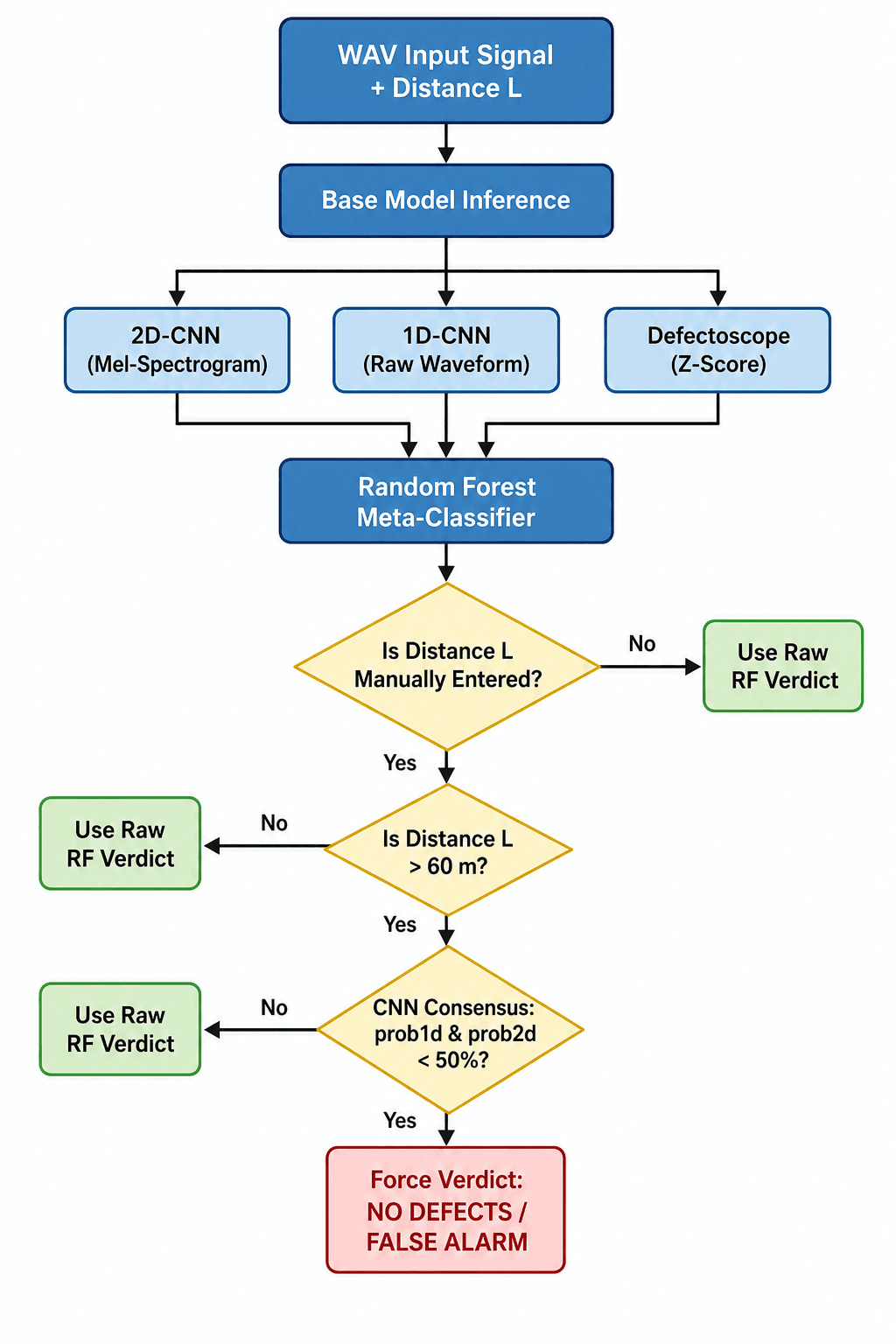
The logic of this hybrid post-filtering algorithm is as follows:
- Input Data: The system receives the raw audio signal from the sensors and the physical distance between them ().
- Parallel Processing: Two independent AI models (edge AI classifier and cloud spectrogram classifier) and the classical correlator analyze the signal in parallel to generate base leak probabilities, which are combined into a final verdict.
- Veto Conditions Check:
- If the sensor distance is missing or does not exceed the critical 60-meter threshold, the system defaults to the base meta-classifier verdict.
- If the distance exceeds 60 meters, the validation filter is activated: the system checks the consensus of the AI models. If both AI models show a leak probability below [threshold value] (failing to confirm a leak), the classical alarm is overridden, and a final verdict of a false positive is issued.
6. Experimental Study and Comparative Analysis
To evaluate the effectiveness of the proposed analytical "veto" filter, we ran a full test suite on a dataset of 110 real-world acoustic records from district heating networks, recorded over various distances. The dataset is divided into three categories: "No leaks" (Normal), "With leaks" (Leak), and "Noisy files" (Noise).
Table 3. Comparative Verification Results Before and After "Veto" Integration
| Performance Metric | Baseline Hybrid Verdict (No Veto) | New Hybrid Verdict (With Veto) | Absolute / Relative Change |
|---|---|---|---|
| Accuracy (Overall) | 50.9% (95% CI: [41.7%, 60.1%]) | 59.1% (95% CI: [49.7%, 67.8%]) | +8.2% (p < 0.004) |
| Precision | 30.6% | 35.8% | +5.2% (abs.) |
| Recall (Sensitivity) | 63.3% | 63.3% | 0.0% (stable) |
| F1-Score | 0.413 | 0.458 | +0.045 |
| False Alarms (False Positives) | 43 | 34 | -20.9% (rel.) |
To assess the statistical significance of the improvements on the paired sample of 110 files, McNemar's exact test was applied. The reduction in classification errors is statistically significant (, which is well below the standard significance level of ). The 95% confidence intervals (CI) calculated using the Wilson score method corroborate the positive shift in accuracy.
Physics-Based Pipeline State Analysis:
The experiment allowed us to compare the behavior of the algorithms across three main physical states of the pipelines:
A. "Leak" State
Characterized by a continuous discharge of fluid under pressure through a defect. This process generates high-frequency acoustic emissions with a dense broadband spectrum in the 2-8 kHz range.
- Neural Network Behavior: Due to the high energy of the signal, the neural classifiers (especially the cloud spectrogram classifier analyzing Mel-spectrograms) output a high leak probability (typically , consistently above [threshold value]).
- Defectoscope Behavior: The cross-correlation Z-score ranges between 4.5 and 8.5.
- Veto Effect: The override block condition (probabilities below [threshold value] for both AI models) is not met. The system lets the true alarm pass, ensuring the recall rate remains stable at 63.3%.
B. "Flow Noise / Turbulence" State
Characterized by turbulent fluid motion, pump station vibrations, or external environmental/traffic noises.
- Defectoscope Behavior: On long spans ( m), wave reflections and high sensor sensitivity cause the analog correlator to identify false phase-match peaks, yielding Z-scores (up to 8.62 in some cases). The baseline Random Forest meta-classifier incorrectly flags this as a "Leak".
- Neural Network Behavior: The neural networks recognize the absence of leak spectral signatures (edge AI classifier outputs leak probability close to zero, cloud spectrogram classifier outputs below [threshold value]).
- Veto Effect: Since m and neither AI model confirms a leak, the veto filter overrides the verdict, changing it to False Alarm. This successfully prevented 9 unnecessary excavations.
C. "Quiet / Sealed / Closed Valves" State
Characterized by a lack of medium movement and pressure on a shut-off pipeline section (e.g., during hydraulic testing or repair outages).
- Defectoscope & Neural Network Behavior: Acoustic energy is near zero. Cross-correlation shows no distinct peaks (Z-score , Peak-to-Noise Ratio (PNR) ). Neural network leak probabilities remain between 0.1% and 5.0%.
- Veto Effect: The system naturally classifies the segment as Normal, requiring no manual intervention from the veto filter.
7. Discussion
7.1 Practical Advantages of the Hybrid Veto Approach
The proposed algorithm offers three principal practical advantages. First, it requires no retraining of the existing classifier: the veto layer is a physics-informed post-decision arbitration step that operates on the outputs of already-deployed models, encoding acoustic propagation constraints that the data-driven classifier cannot learn from a 2.9%-labeled dataset. Second, it maintains full backward compatibility with historical diagnostic logs — records without distance metadata are processed identically to the pre-integration baseline. Third, the decision logic is fully transparent and auditable by NDT specialists, which is essential for regulatory acceptance in municipal infrastructure diagnostics.
7.2 Limitations
The approach has several limitations that should be explicitly acknowledged. The binary nature of the veto (applied when m and ensemble neural network consensus < [threshold value]) introduces a hard decision boundary that may be suboptimal for pipeline configurations near the threshold. The 60-meter value is specific to the investigated district heating network and should be re-calibrated for networks with different pipe materials, diameters, or sensor types. Furthermore, the veto currently operates only on the distance parameter; other potentially informative metadata fields (pipe material, insulation age, soil type) are not yet incorporated into the filtering logic.
7.3 Threats to Validity
Three categories of threats to the validity of the experimental results should be considered. Internal validity: the test set () was manually verified, introducing potential selection bias toward cases with clearer diagnostic outcomes. Construct validity: the McNemar test and Wilson confidence intervals assume the error changes are paired and independent across records, which may not hold if multiple records originate from the same pipeline section. External validity: the results were obtained on a single urban district heating network with a specific sensor model; generalization to other network types (water distribution, gas) requires additional validation.
7.4 Future Work
Two directions are prioritized for near-term development. First, following the regulatory update described in Section 7 of the Conclusion — under which NDT specialists now systematically record distance parameters for new diagnostic sessions — sufficient labeled data is expected to accumulate within 12–18 months to enable full meta-classifier retraining (Option 3), replacing the physics-informed arbitration rule with a fully learned distance-conditioned confidence function — completing the transition from physics-compensated to end-to-end physics-aware machine learning. Second, the veto mechanism will be extended to incorporate pipe material and insulation class as additional filtering dimensions, enabling a multi-parameter spatial metadata integration strategy.
8. Conclusion
Integrating spatial metadata (sensor distance ) is essential to compensate for the physical limitations of cross-correlation DSP algorithms in acoustic testing on sections longer than 60 meters.
Under real-world operations characterized by severely incomplete historical databases (only 2.9% of records had distance metadata), full machine learning model retraining (Option 3) leads to overfitting and poor generalization. The implemented hybrid post-filtering with a smart veto switch (Option 4) provides a robust compromise. It preserves backward compatibility with historical logs while targeting and suppressing false alarms on long spans when spatial parameters are explicitly entered by the operator.
The deployment of this compromise algorithm has yielded significant organizational and technological benefits. It effectively demonstrated the practical value of AI-based acoustic analysis to non-destructive testing (NDT) specialists, stimulating the transition toward systematic collection of verified field audio reports. Consequently, internal diagnostic regulations have been updated to mandate that operators preserve raw audio signals alongside precise pipeline geometric metadata. The accumulation of this structured database will soon eliminate the training data scarcity, enabling full retraining of the machine learning models and facilitating a seamless transition to the target Option 3—an end-to-end meta-classifier that integrates spatial features directly within a single feature space.
Field testing on a 110-file dataset demonstrated a 20.9% reduction in false alarms with zero risk of missing real leaks, validating the integration of this logic into production runs of the RIVIXI AI platform.
Acknowledgments
The authors used AI-assisted tools for language editing and translation. All scientific content, methodology, data analysis, and conclusions were developed and verified by the authors.
References
- Fuchs, H. V., & Riehle, R. (1991). Ten years of experience with leak detection by acoustic signal analysis. Applied Acoustics, 33(1), 1–19. https://doi.org/10.1016/0003-682X(91)90062-J
- Hunaidi, O., & Chu, W. T. (1999). Acoustical characteristics of leak signals in plastic water distribution pipes. Applied Acoustics, 58(3), 235–254. https://doi.org/10.1016/S0003-682X(99)00013-4
- Gao, Y., Brennan, M. J., Joseph, P. F., Muggleton, J. M., & Hunaidi, O. (2004). A model of the correlation function of leak noise in buried plastic pipes. Journal of Sound and Vibration, 277(1–2), 133–148. https://doi.org/10.1016/j.jsv.2003.08.045
- Liang, H., Gao, Y., Li, H., Huang, S., Chen, M., & Wang, B. (2023). Pipeline leakage detection based on secondary phase transform cross-correlation. Sensors, 23(3), 1572. https://doi.org/10.3390/s23031572
- Nguyen, D. T., Nguyen, T. K., Ahmad, Z., & Kim, J. M. (2023). A reliable pipeline leak detection method using acoustic emission with time difference of arrival and Kolmogorov–Smirnov test. Sensors, 23(23), 9296. https://doi.org/10.3390/s23239296
- Peng, L., Zhang, J., Lu, S., Du, G., & Li, Y. (2023). One-dimensional residual convolutional neural network and percussion-based method for pipeline leakage and water deposit detection. Process Safety and Environmental Protection, 177, 1142–1153. https://doi.org/10.1016/j.psep.2023.07.059
- Choi, J., & Im, S. (2023). Application of CNN models to detect and classify leakages in water pipelines using magnitude spectra of vibration sound. Applied Sciences, 13(5), 2845. https://doi.org/10.3390/app13052845
- Peng, H., Xu, Z., Huang, Q., Qi, L., & Wang, H. (2024). Leakage detection in water distribution systems based on logarithmic spectrogram CNN for continuous monitoring. Journal of Water Resources Planning and Management, 150(6), 04024018. https://doi.org/10.1061/JWRMD5.WRENG-6276
- Boujelben, M., Benmessaoud, Z., Abid, M., & Elleuchi, M. (2023). An efficient system for water leak detection and localization based on IoT and lightweight deep learning. Internet of Things, 24, 100995. https://doi.org/10.1016/j.iot.2023.100995
- Guo, P., et al. (2024). Leak detection in water supply pipeline with small-size leakage using deep learning networks. Process Safety and Environmental Protection, 191, 2712–2724. https://doi.org/10.1016/j.psep.2024.10.011
- Peng, L., Huang, W., Du, G., Li, Y., & Zhang, J. (2024). Automatic pipeline fault detection using one-dimensional convolutional bidirectional long short-term memory networks with wide first-layer kernels. Structural Health Monitoring, 23(6), 3832–3849. https://doi.org/10.1177/14759217241227995
- Liu, Y., Xie, W., Guo, Q., & Wang, S. (2025). Enhancing pipeline leakage detection through multi-algorithm fusion with machine learning. Processes, 13(5), 1519. https://doi.org/10.3390/pr13051519
- Satterlee, N., Zuo, X., Lee, C. W., Park, C. W., & Kang, J. S. (2025). Parallel multi-layer sensor fusion for pipe leak detection using multi-sensors and machine learning. Engineering Applications of Artificial Intelligence, 153, 110923. https://doi.org/10.1016/j.engappai.2025.110923
- Shafer, G. (1976). A Mathematical Theory of Evidence. Princeton University Press. ISBN 978-0-691-10042-6
- Wang, W., & Gao, Y. (2023). Pipeline leak detection method based on acoustic-pressure information fusion. Measurement, 212, 112691. https://doi.org/10.1016/j.measurement.2023.112691
- Baroudi, U., Al-Roubaiey, A. A., & Devendiran, A. (2019). Pipeline leak detection systems and data fusion: A survey. IEEE Access, 7, 97426–97439. https://doi.org/10.1109/ACCESS.2019.2928487
- Zhou, S., O'Neill, Z., & O'Neill, C. (2018). A review of leakage detection methods for district heating networks. Applied Thermal Engineering, 137, 567–574. https://doi.org/10.1016/j.applthermaleng.2018.04.010
- Ye, S., Yu, F., Hao, M., Cui, K., et al. (2025). Leakage diagnosis technologies for heating pipe networks: A comprehensive review of currently used methods. International Journal of Energy Research, 2025, 8824853. https://doi.org/10.1155/er/8824853
- Yang, G., Xing, D., & Wang, H. (2024). Leak localization in district heating networks integrating physical model-based and data-driven methods: Impact of dataset construction on model performance. Energy, 308, 132839. https://doi.org/10.1016/j.energy.2024.132839
- Raissi, M., Perdikaris, P., & Karniadakis, G. E. (2019). Physics-informed neural networks: A deep learning framework for solving forward and inverse problems involving nonlinear partial differential equations. Journal of Computational Physics, 378, 686–707. https://doi.org/10.1016/j.jcp.2018.10.045
- Britton, L. G., & Willey, R. J. (2024). Avoiding water hammer and other hydraulic transients. Process Safety Progress, 43(1), 101–112. https://doi.org/10.1002/prs.12517
- Pérez-Pérez, E. J., López-Estrada, F. R., Valencia-Palomo, G., Torres, L., Puig, V., & Mina-Antonio, J. D. (2021). Leak diagnosis in pipelines using a combined artificial neural network approach. Control Engineering Practice, 107, 104677. https://doi.org/10.1016/j.conengprac.2020.104677
Citation
This research paper is permanently archived as a preprint on Zenodo:
Ivanaiskii, A., Ivanaiskii, E., & Shipilov, S. (2026). Optimizing Hybrid Ultrasonic Testing Algorithms for District Heating Networks under Incomplete Spatial Metadata [Preprint]. Zenodo. https://doi.org/10.5281/zenodo.21431110