AI vs. Metallography: Accelerating Outage Inspection in 2.25Cr-1Mo Steel Pipelines via MBN-RVX-AI
Evgeny Ivanaiskii, PhD
Domain Expert
Aleksandr Ivanaiskii, PhD
Industrial AI Founder & Systems Architect
Sergei Shipilov
AI Architecture Lead, Rivixi LLC
Abstract
Microstructural degradation assessment in boiler tubes and steam pipelines at thermal power plants (TPPs) is strictly performed during planned shutdowns (Outages / Shutdowns), when the system is completely cooled and depressurized. Traditional replica metallography is a major bottleneck during outages due to its slow, labor-intensive, and subjective nature. This paper presents a rapid non-destructive screening method based on MBN-RVX-AI technology (magnetic Barkhausen noise + AI) for 2.25Cr-1Mo and similar steels operating in hazardous industrial facilities and prone to structural changes during operation, leading to the formation of defects in the metal. By digitizing the 1D signal using an industrial DAQ (ADC) board, converting it into 2D spectrograms, and classifying it via an AI model, we automate structural evaluation. The model achieves an accuracy of over 92%. We describe the cloud integrated pipeline architecture to enable automated real-time cross-verification (double control) of steel microstructures on-site.
1. Introduction: The Outage Bottleneck in High-Temperature Metallography
The operational reliability of high-temperature steam lines made of chromium-molybdenum steel 2.25Cr-1Mo (standardized as ASTM A335 Grade P22 or A213 T22 in US power systems) is critical to TPP safety. Long-term thermal aging () causes carbide spheroidization, graphitization, and creep voiding.
Evaluating these structural changes under high operating temperatures or pressures is strictly impossible and prohibited due to obvious safety hazards. Structural testing (both traditional replicas and alternative digital camera methods) is performed exclusively during planned boiler shutdowns (Outages / Shutdowns) once the piping has cooled.
However, even during planned outages, traditional metallographic replication poses significant operational challenges:
- Slow Inspection Cadence: Preparing a single test spot requires grinding, polishing with progressively fine diamond pastes to a mirror finish, acid chemical etching, and capturing a replica on acetate film.
- Subjective Assessment: Replica quality depends heavily on manual preparation. Microstructure scoring is done manually by an expert metallurgist, introducing a significant risk of human error.
- Localized spot inspection (Control "at a point"): A metallographic replica is captured from a tiny area of a few square millimeters. Due to the labor-intensive nature of the method, only isolated spots are inspected, whereas creep defects can develop across the entire length of a pipe bend. A 100% audit of pipe bends is impossible within short outage windows.
Solution: Rapid NDT Cross-Verification (Double Control)
To mitigate these risks, QA/QC standards in international practice mandate double control (cross-verification). We propose using the MBN-RVX-AI technology as a rapid, high-coverage scanning tool.
Field technicians scan the inspected pipeline bend with a portable sensor, obtaining a continuous profile of the metal's condition. Traditional metallographic replicas are then taken selectively—only for targeted verification in zones where the AI analysis flags MBN signal anomalies.
2. Physical Mechanism of Magnetic Barkhausen Noise (MBN)
The method relies on registering magnetic noise generated during the cyclic remagnetization of 2.25Cr-1Mo ferromagnetic steel.
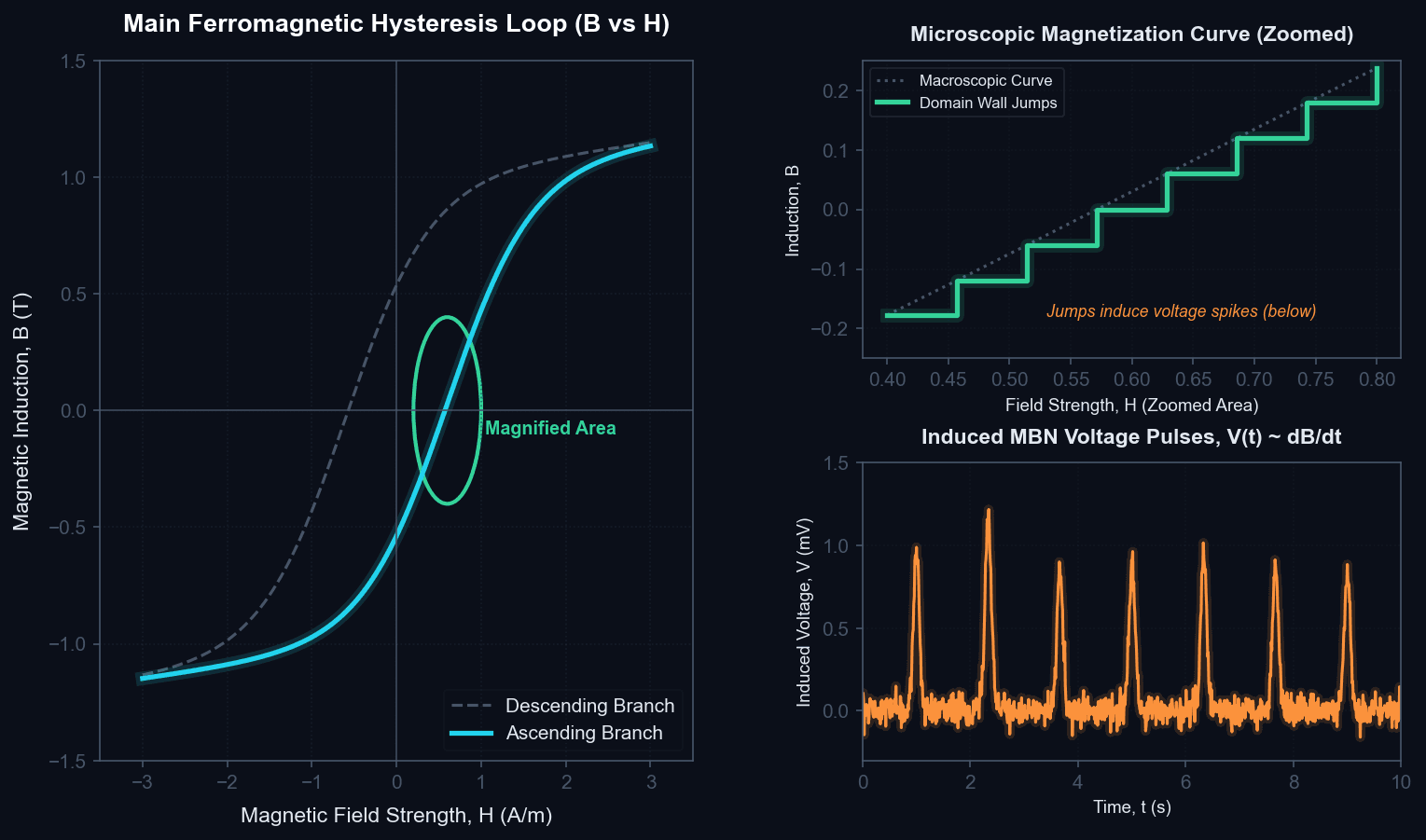
As the external magnetic field cycles, magnetic domain walls (Bloch walls) move through the steel matrix in discrete jumps. Microstructural defects—grain boundaries, spheroidal carbides, graphitic nodules, and creep voids—act as pinning sites that obstruct this motion.
Each abrupt wall jump induces a tiny voltage pulse in an inductive sensor. This physical phenomenon is represented by step-like changes in the magnetization curve (hysteresis loop) and is illustrated in the diagram below:
The spectral composition and power of the resulting noise directly correlate with the steel degradation stage:
- Initial State (Ferrite-Pearlite): Few domain-wall pinning sites exist. The signal exhibits high-amplitude pulses across the mid-frequency range.
- Spheroidization & Graphitization: Carbides precipitate along grain boundaries, forming a dense network of pinning sites that shifts the MBN frequency distribution.
- Voids & Microcracks (Pre-rupture Stage): Chains of grain-boundary pores and microcracks block domain wall propagation, causing signal damping and significant drops in spectral power.
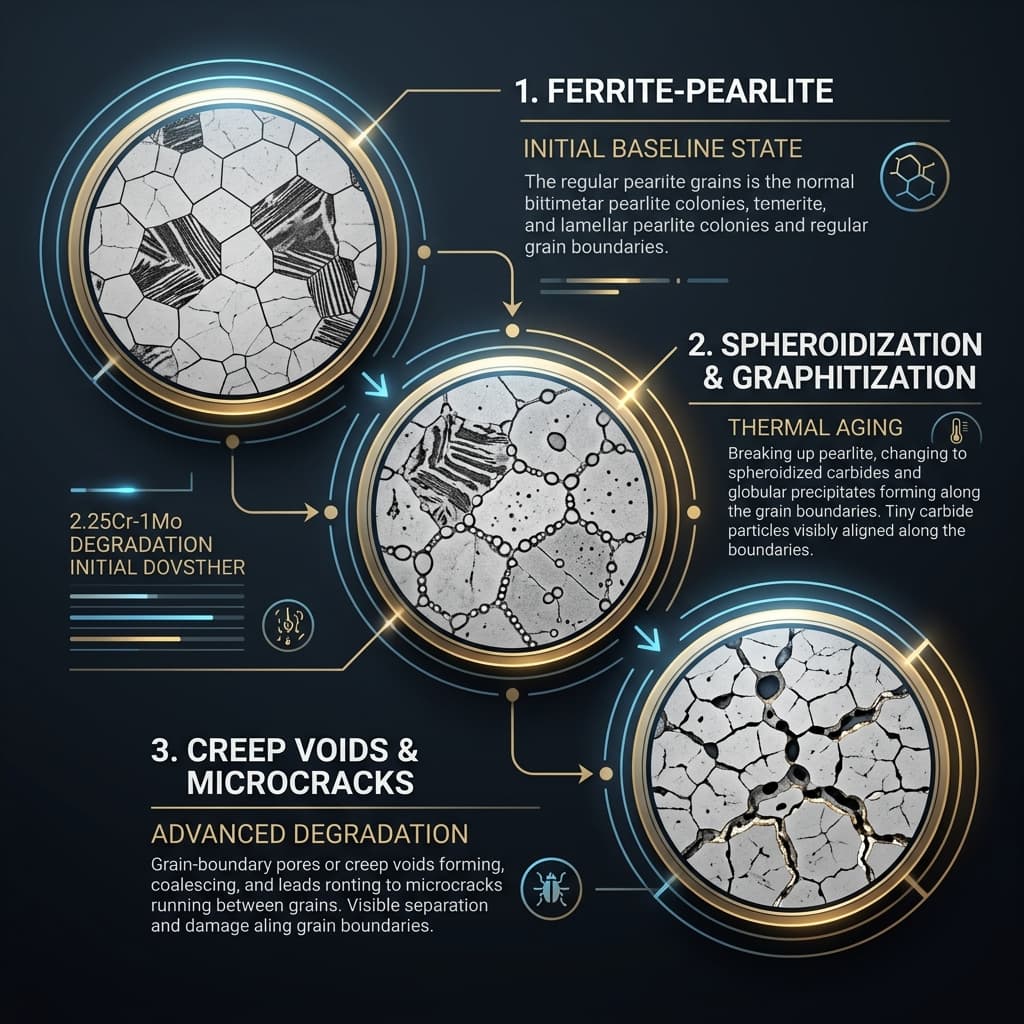
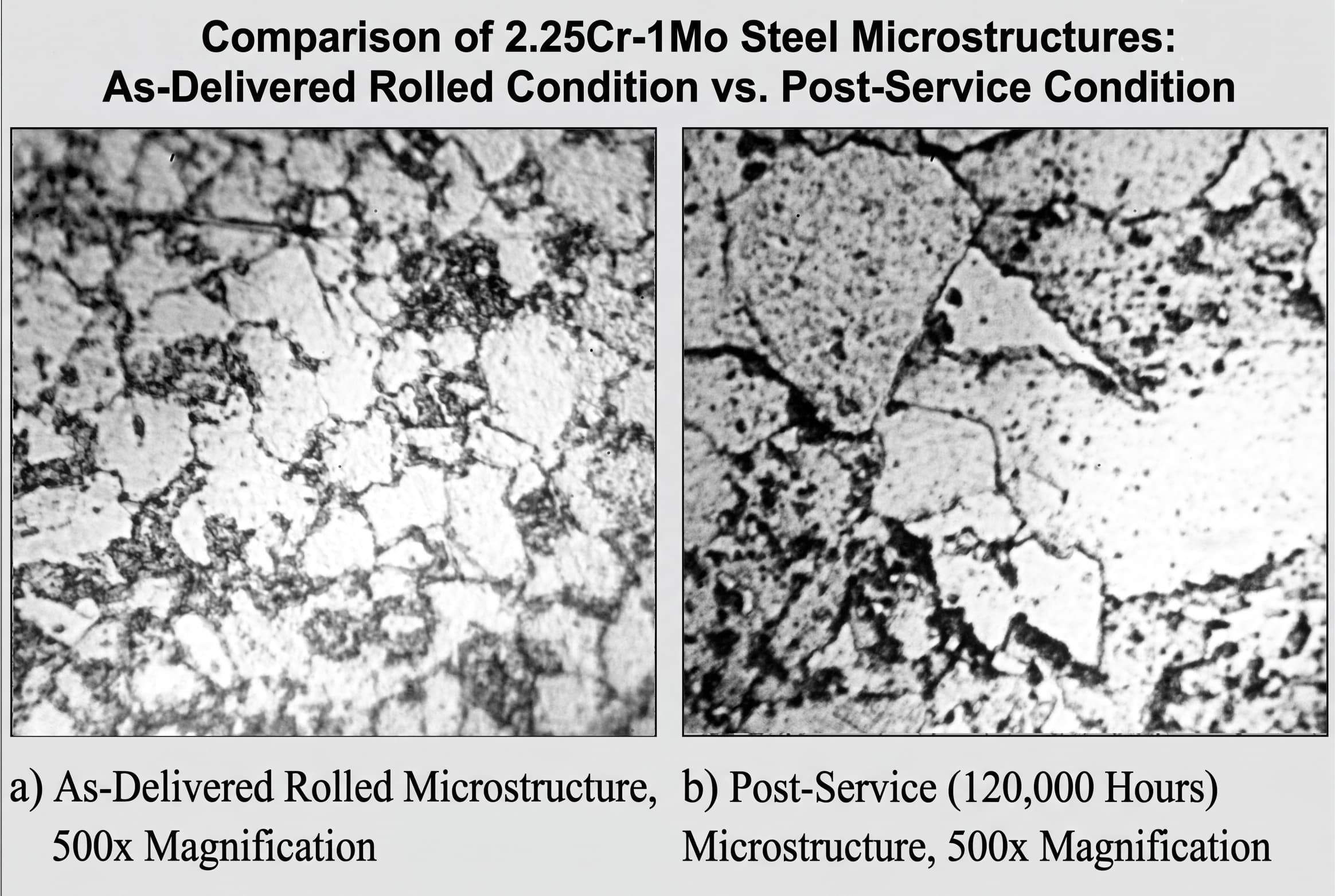
The schematic above highlights the structural defect stages. Real optical microstructures of the tested steel are shown below:
3. Data Acquisition Pipeline
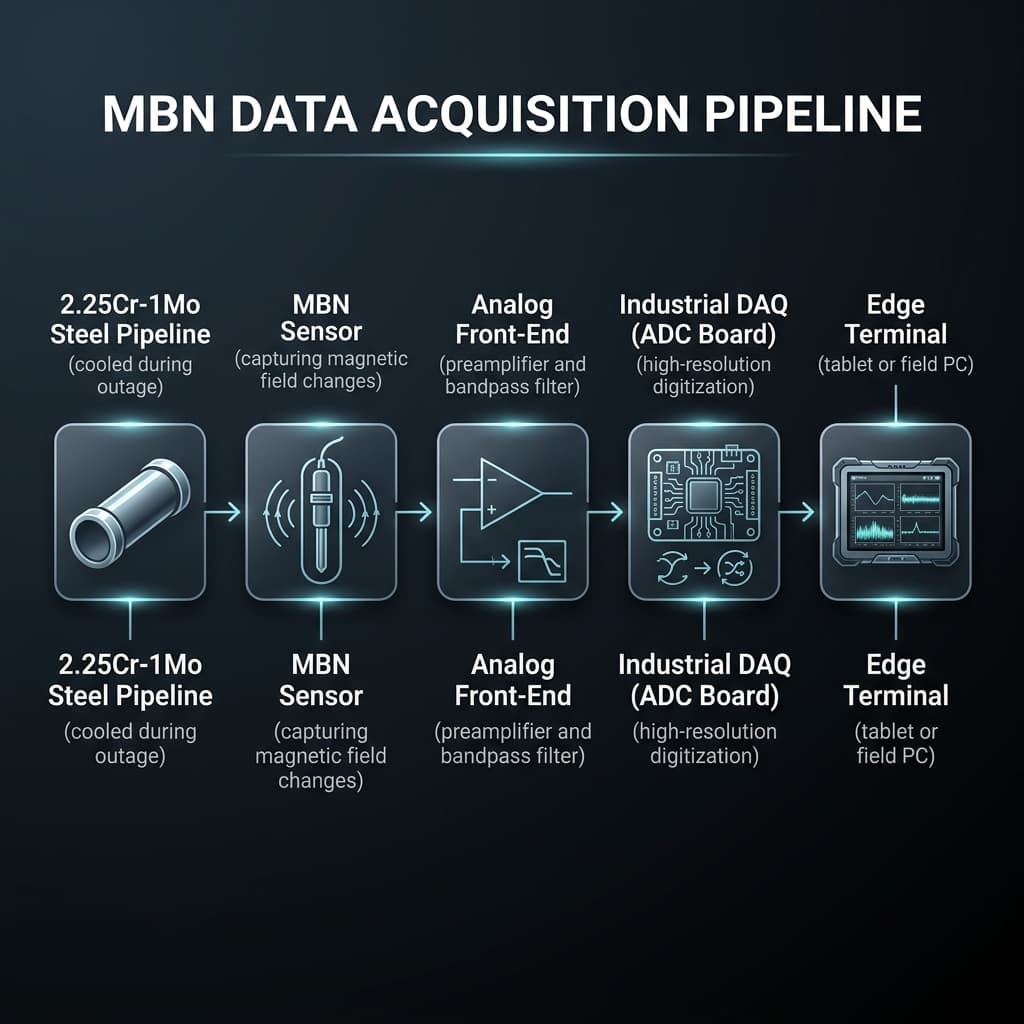
To acquire clean signals, weak MBN voltage pulses from the sensor are routed through an analog front-end (pre-amplifier and bandpass filter) and digitized via an industrial high-resolution Data Acquisition (DAQ) card / ADC board. This configuration ensures high sampling rates and excellent noise immunity.
4. RVX-AI Technology Concept: Cloud Integration
Instead of local analysis on heavy computers, we have transferred the signal processing and AI logic to cloud architecture. This allows for a flexible and scalable workflow algorithm:
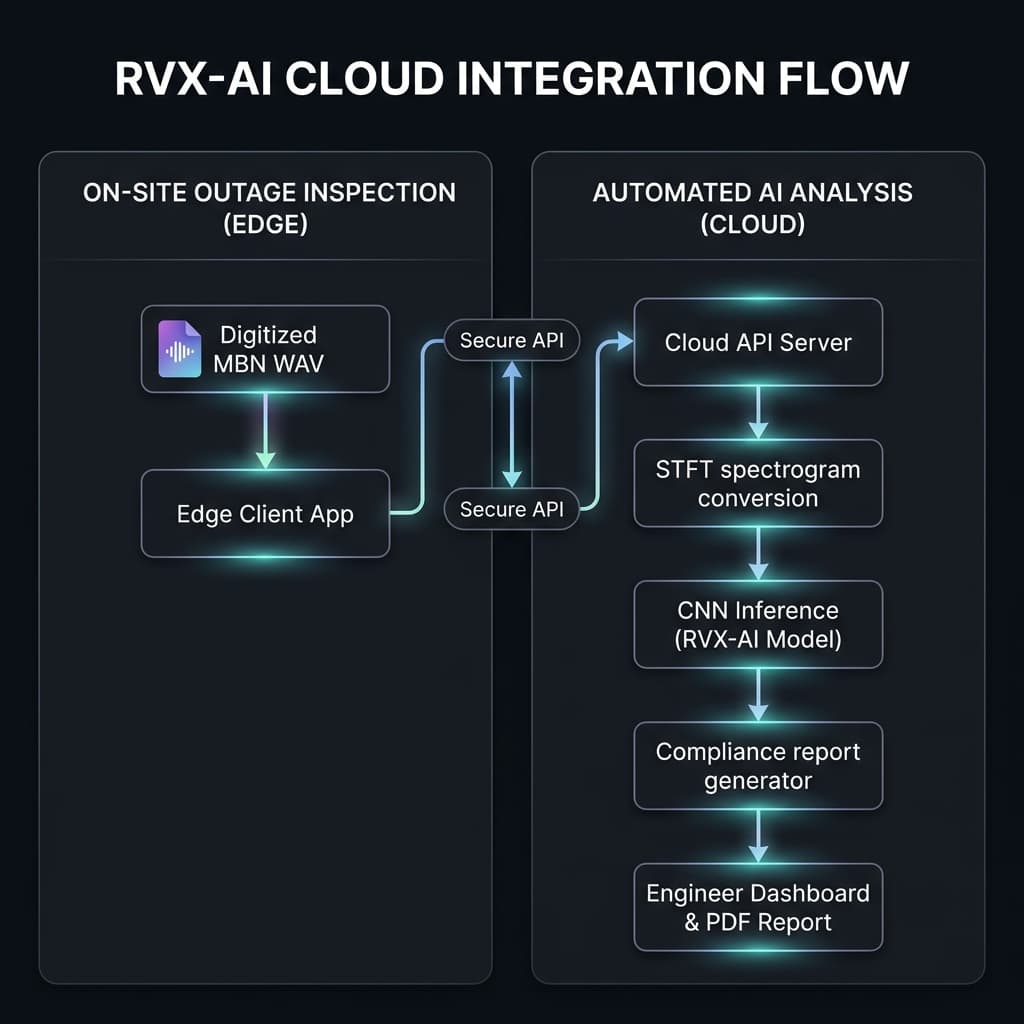
Operation Algorithm
- Hardware: A portable MBN scanner connects to a field engineer's tablet or industrial smartphone via a smart USB/Bluetooth interface.
- On-Site Scan: During the shutdown window (Outage), the technician sweeps the probe over the controlled zone (pipe bend). The Edge App records and digitizes the signal.
- Cloud AI Analysis: The app automatically transmits the digital recording to the Rivixi Cloud server. In parallel, measurements are saved to the device's internal memory (up to 200 scans) for backup storage and post-processing. A Python microservice converts the signal into a spectrogram and runs inference using the trained RVX-AI convolutional model.
- Instant Verdict: The app displays an integrated metal structure assessment for the scanned zone (normal/degraded) and flags if a targeted replication check is required. The data is instantly written to the pipeline's digital asset passport.
5. Signal Processing & AI Model Architecture
The classification task is formulated as a binary classification problem to distinguish between acceptable structural states (without critical defects) and unacceptable structural degradation (containing microstructural defects like creep voids or advanced spheroidization). For training, a dataset was constructed using steel specimens in baseline condition and specimens with verified microstructural defects (sourced from service-exposed pipes after 120,000 hours of operation), representing the two physical extremes. This binary formulation serves as a baseline feasibility study (Proof-of-Concept) to confirm the sensitivity of Magnetic Barkhausen Noise (MBN) spectral features to microstructural alterations in 2.25Cr-1Mo steel, paving the way for multi-class creep damage regression once intermediate samples are acquired.
5.1 Signal Preprocessing and Feature Extraction
The raw continuous 1D magnetic Barkhausen noise signals are digitized at a high sampling rate (up to 100 kHz) and preprocessed through the following pipeline:
- Segmentation & Data Augmentation: The continuous time-series is segmented into overlapping temporal windows of duration seconds with a 50% overlap. This ensures signal stationarity within each window and expands the training dataset.
- Short-Time Fourier Transform (STFT): A spectrogram is computed for each segment using a Hanning window (window size and hop length ).
- Logarithmic Scaling: The raw amplitude spectrogram is mapped to the decibel scale () to compress the massive dynamic range of the Barkhausen jump amplitudes.
- Normalization & Resizing: The resulting spectrogram is Min-Max normalized to the range and bilinearly interpolated to a size of pixels, yielding a single-channel grayscale tensor representing the spectral-temporal power density.
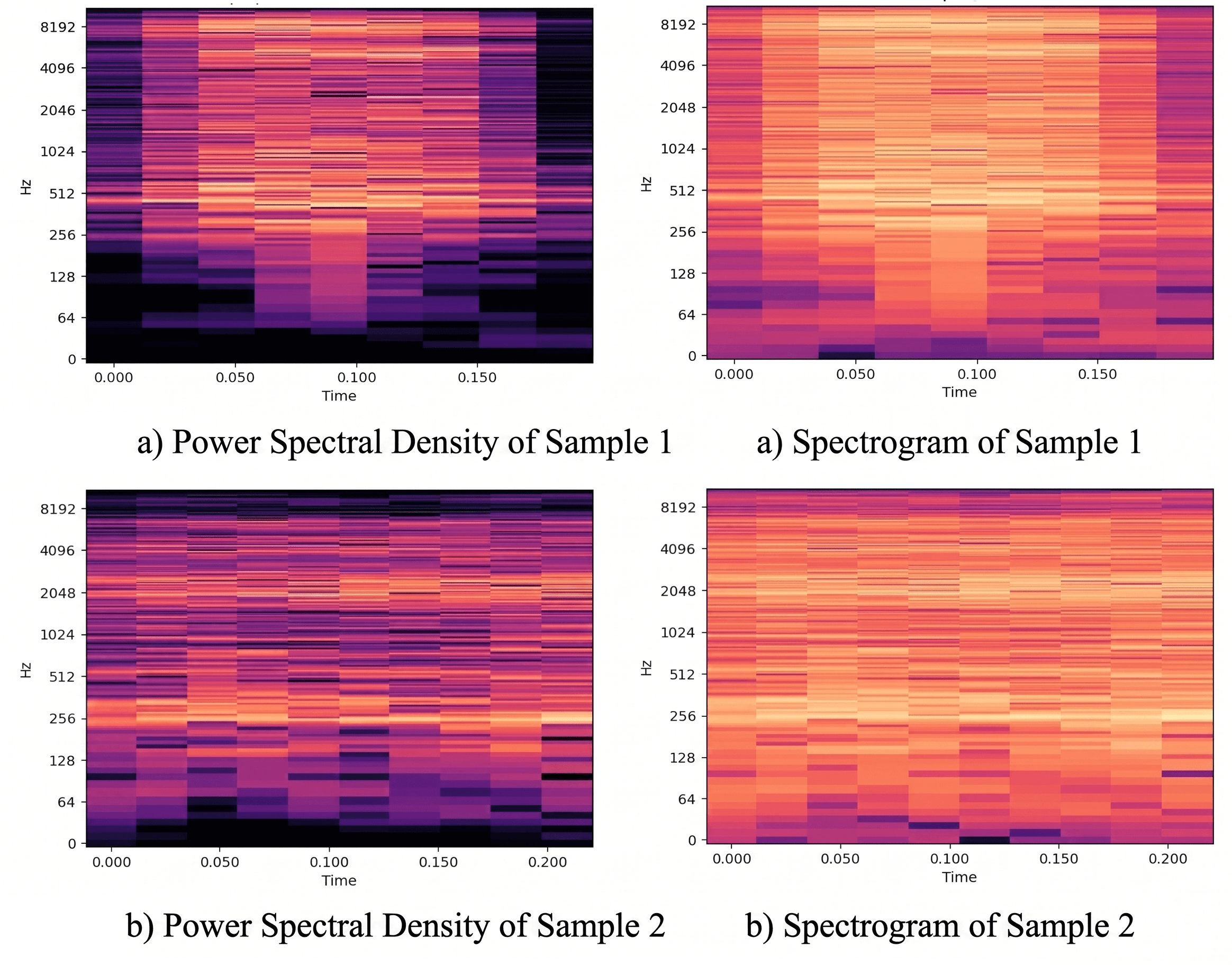
The resulting spectrogram represents the power spectral density across time and frequency:
5.2 AI Model Architecture
Spectrogram images are evaluated by a custom cloud spectrogram classifier designed for efficient edge-deployment and optimized for physical wave features:
- First Convolutional Block: Extracts local spectral-temporal textures (Conv2d layer with 32 filters of size , ReLU activation) followed by spatial reduction (MaxPool2d layer of size , reducing dimensions to ).
- Second Convolutional Block: Extracts high-level frequency shift patterns (Conv2d layer with 64 filters of size , ReLU activation) followed by spatial reduction (MaxPool2d layer of size , reducing dimensions to ).
- Fully Connected Classifier: Feature maps are flattened (Flatten) into a vector of length 262,144, routed through a hidden dense layer (64 units, ReLU), a Dropout regularization layer ( to prevent overfitting on the polar classes), and a final Dense output layer with a Sigmoid activation function to estimate the degradation probability .
5.3 Training Protocol and Data Leakage Mitigation
The dataset was split using a 70% training / 15% validation / 15% testing partition strategy.
IMPORTANT — Data Leakage Mitigation (Specimen-Level Split): To ensure rigorous evaluation, the train/val/test split was performed strictly at the specimen / pipe level rather than the window level. Windows generated from the same physical pipe segment were kept together in the same subset and never split across subsets. This guarantees that validation and test accuracies evaluate model generalization on unseen pipeline components.
Training Configurations:
- Loss Function: Binary Cross-Entropy (BCE) Loss:
- Optimizer: Adam optimizer with a learning rate of and L2 regularization (weight decay = ).
- Regularization: Standard Dropout layer () combined with an Early Stopping mechanism monitoring validation loss (patience of 5 epochs). The model typically converged within 25–30 epochs.
- Model Evaluation: The classifier reached an Accuracy above 92% on the independent test set, with an Area Under the ROC Curve (AUC-ROC) exceeding 0.96, validating the scientific viability of the MBN-RVX-AI screening approach.
5.4 Code Availability (GitHub Repository)
For ML practitioners and NDT researchers interested in replicating these experiments or adapting the signal processing pipeline, the complete source code detailing MBN signal preprocessing, PyTorch AI model declaration, and training scripts has been open-sourced:
👉 MBN-RVX-AI GitHub Repository
6. Industrial Outcomes and Discussion
Deploying the MBN-RVX-AI pipeline during planned shutdowns significantly reduces total inspection duration and labor costs.
Outage Inspection Method Comparison
| Feature | Classical Replication (Metallography) | AI-Enabled Screening (MBN-RVX-AI) |
|---|---|---|
| Surface Prep Time | Fine polishing to mirror finish (30-40 min) | Surface preparation (10 min) |
| Inspection Time per Bend / Zone | 1.5 to 2 hours | Around 10 minutes (including scanning) |
| Inspection Zone Character | Local spot (a few sq. mm) | Full scanning of the controlled zone |
| Expert Interpretation | Required on-site (subjective manual review) | Automated cloud verification (objective AI) |
| ERP & Asset Management | Manual data entry | Automatic API sync with asset database |
Conclusion
By migrating to the MBN-RVX-AI technology, diagnostic laboratories can resolve a critical shutdown bottleneck. Line operators can perform high-speed, continuous screening of 2.25Cr-1Mo steel pipelines on-site, routing expensive metallurgists to perform targeted replication only in anomalous areas. This strategy reduces outage NDT schedules by 40-50% while improving safety assurance across industrial boiler plants.
Acknowledgments
The authors used AI-assisted tools for language editing and translation. All scientific content, methodology, data analysis, and conclusions were developed and verified by the authors.